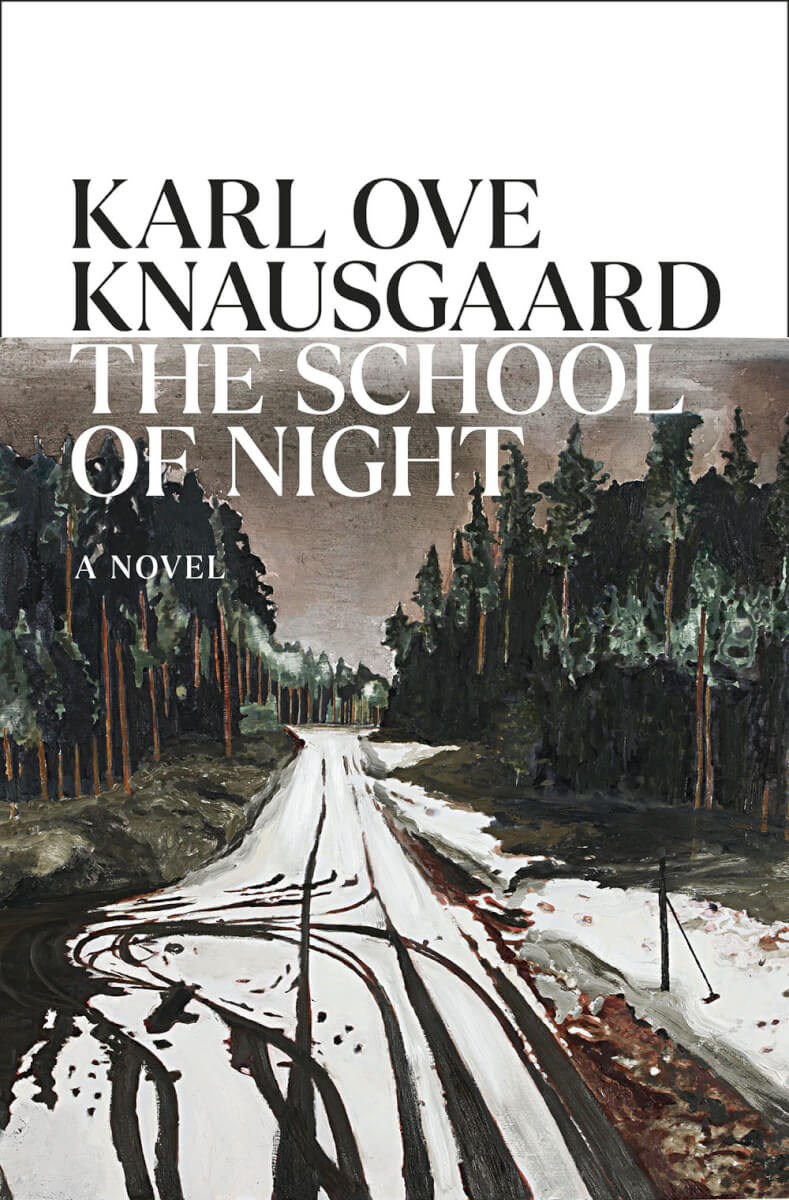
Nearly a century after debuting in Hermann Hesse’s Steppenwolf, the character Harry Haller has reemerged, still on the prowl, as a famous Norwegian photographer in London. Well, not exactly.
To be sure, Kristian Hadeland, the protagonist of Karl Ove Knausgaard’s The School of Night, is something of a lone wolf. Like Haller, he has didactic and pedantic views on art. But rather than being consumed with Haller’s self-loathing, the thin-skinned Kristian is so inflated with his own sense of worth that his ego would barely fit into a blimp hangar.
Knausgaard, who is much feted in Norway (his first book, Out of the World, was the first ever debut novel to win the Norwegian Critics’ Prize), shares something with his creation as well: Both threw a Molotov cocktail into their familial relationships in pursuit of artistic truth. In the bestselling, six volume, 3,600-page series My Struggle, Knausgaard wrote his own autobiography in such excruciating and penetrating detail that he has become estranged from many in his family.
When we meet Kristian at the outset, he too has decided to set his story down for posterity, in his case as a last grand gesture prior to suicide. Like J. Alfred Prufrock in T.S. Eliot’s poem, Kristian has seen the moment of his greatness flicker, but he takes us back to his early student days (London, 1985) when all was promise and theory. Back then, a Dutch artist named Hans served as an unusual mentor.
Hans and his circle are involved in the occult writings of Aleister Crowley, and are putting on an amateur production of Christopher Marlowe’s Doctor Faustus. As Kristian is drawn into the group, his fortunes begin to change for the better. Toward the end of the first part of the novel, Kristian has gotten himself into a spot of trouble with the law, and his rescue, courtesy of Hans, implies that something more than simple luck and friendship may be impelling his swift rise.
Twenty-odd years later, the photographer sits astride the apex of the art world, with a retrospective at the Museum of Modern Art and all the attendant publicity it entails. Just at the point of maximum career apogee, in a moment of hubris, Kristian recounts his earlier police encounter in such a way as to make himself look guilty. Very guilty.
In many ways this is an ancient story, with a through line to Icarus, Faustus, A Face in the Crowd, Cruel Intentions and so many more. Karma is not kind. In Knausgaard’s hands, doled out a little at a time around the edges before coming due spectacularly at the conclusion, it’s the makings of a work of magisterial literary prowess.