Contemplating why people learn to fly feels obvious to those who have done it—more Why wouldn’t you? than Why would you? It’s unlike anything else you learn to do as an Earthbound beast, and in most ways, you’re not supposed to be doing it. So why wouldn’t you put yourself in a tiny open-cockpit experimental (experimental?!) aircraft named after the cartoon bird Woodstock (too unserious) and fly over the Sierra Nevada? Why not throw yourself into turbulence, or narrowly miss birds, or squeeze yourself into an airport traffic pattern while someone else nearly runs you down?
Good questions all, bestselling author Caroline Paul (Tough Broad) says, and then delightfully and ever-so-coolly shares some answers in Why Fly: Seeking Awe, Healing, and Our True Selves in the Sky. Against the backdrop of aviation history, and with slender threads tying the results to the end of her marriage, Paul welcomes us to the sky and shows what it has to offer.
Every good aviation book begins with an engine cutting out, and yours does too. Why? Won’t it scare away the civilians?
Why Fly is really a meditation on the way flight can expand a life, not endanger it! But yes, I knew an emergency landing might freak readers out. However, it also prompts them to really ponder the central question, Why fly? I mean, I asked myself that too, after it happened. But I didn’t dwell on it for long. The benefits of flight quickly compensate for the irregularities, and I bring readers along on that.
Speaking of civilians, your book does a pretty perfect job of writing for both pilots and nonpilots. How did you find that line?
The book is not just about flight, it’s also about the human heart. I become obsessed with flying a strange-looking experimental aircraft called a gyrocopter as my marriage is falling apart. I write a lot about the parallels between flight and love, even dying love. I think that deepens the book and captures nonpilots who won’t immediately relate to flight alone. Ultimately, I wrote the book for nonpilots because I don’t think I have anything new to say to pilots. I’m no “expert” on flight. But if pilots find something here to love, I’m honored.
It’s hard to talk about how flying feels, and even harder to write about it. I was recently reading Louise Thaden’s memoir, High, Wide, and Frightened, and she spends only a single sentence on the fact that someone tried to sabotage her airplane during an air race. A single sentence—glad we caught that! she goes—and then back to flying. Why do you think it’s so hard to write about? The good and the scary? Is it because of the concept of awe?
Flight triggers primal reactions—awe, certainly and in many people, terror. It’s hard to write about emotions that a reader feels deeply and so thinks she understands. As an author, I try to show these feelings in a newer light, something that will be at once recognizable but also surprising. It helps that I explore flight through small, very light open-cockpit aircraft like paragliders and gyrocopters. Contrast that to flight on passenger planes, which either scare us or inconvenience us or leave us cramped and aching. That kind of flight makes it easy to forget the miracle (and the physics) that is overcoming gravity and catapulting across the sky. But travel with me in my open-cockpit gyrocopter and you understand how it feels to fly.
One of my favorite (littler) stories in your book is about flying over the Golden Gate Bridge and feeling like there’s no way you should be allowed to do it, but you can, if you know the rules! That’s something I loved learning as a pilot: The more knowledge I had of the rules, the more freedom I felt. We don’t always think of our adventurers as sticklers for standards, but in aviation, the safe ones are. Would you call yourself a rule-follower?
I picked up paragliding in the mid ’80s. The sport was new; there were essentially no rules at all. No certifications, no mandate to even take lessons. Same with flying experimental “trikes” (motorized hang gliders) in the early 2000s—the only real rule was, You’re a nuisance, stay out of the way. Many airports prohibited us. It was hard to fix your aircraft when something went wrong. This we-are-outlaws environment made flying attractive to the younger me, but also much more dangerous, to be honest. Once I was told to follow rules (the FAA folded us into a new category, called Sport Pilot), I did. Rules make you a better pilot, no doubt about it.
You have some especially harrowing stories, from your trike’s engine failure to getting “cloud sucked” while paragliding. What keeps you flying? Have you ever nearly quit?
There have been a few close calls, which come when you fly these tinier, experimental aircraft. Simply put, they are more vulnerable to burly weather and your own bad judgment. But quit? The pros always outweigh the cons. Flying exposes me to sights and adventures that make me a more sensitive, and more humble, human. Without it, I am not sure how I could have handled the devolvement of my marriage. There was something about becoming a better and better pilot, even as I was getting worse and worse at partnership, that steadied me.
“Flight triggers primal reactions—awe, certainly and in many people, terror. . . . I try to show these feelings in a newer light.”
Several sections, including the chapter on how winds are changing, ask readers to pay more attention to the Earth amid climate change. Do you think flying has made you pay better attention to the world?
We call it “situational awareness”: that ability to assess not just what is in front of you but peripheral circumstances, and factor it all into your current experience. Pilots are trained in this. Also, I fly very lightweight, open-cockpit aircraft, and that makes me part of the environment whether I like it or not. The wind is tossing me around and pummeling my flight suit, the sun is bearing down on my face, every temperature change is palpable, the landscape is unfurling underneath my feet far below. Flying becomes very kinetic, very physical, very elemental. It taps into deep emotions, like awe and fear. I really feel more fully human, even as I am trying to be avian. To that end, sometimes those fancy avionics seem to be a shame, because they keep the flight experience very screen-based. Pilots of bigger aircraft hardly look out the window, it seems, which is why I prefer to streamline my instruments and keep to open-cockpit flight.
What guided your research and choosing which historical stories to include?
I didn’t want a comprehensive book about the history of flight—there are writers much better equipped for that. Instead, I wanted to give readers a sense of why flight changes those who do it, as well as its impact on the world in general. The historical touch points range from Felix Baumgartner jumping from a balloon in the stratosphere, to the way we are obsessed with helping birds discover their old migration patterns by raising them to follow motorized paragliders, to the Night Witches, Russian women who had to fly biplanes against the highly advanced Nazi fighters. Through aircraft we express these crazy human compulsions, whether it is to make war, or control nature, or set new records.
“The book is not just about flight, it’s also about the human heart. I become obsessed with flying a strange-looking experimental aircraft called a gyrocopter as my marriage is falling apart.”
What are your favorite aviation books?
I love The Dog Stars by Peter Heller and Aloft by Chang-rae Lee. Both are fiction and feature pilots, though the stories don’t center aviation the way, say, a book by St. Exupéry might. However, their writing is beautiful, the narratives compelling, and each author expertly captures what it feels like to fly.
What was your favorite thing to research while writing this book?
I was surprised to find that we don’t fully understand the physics of flight. When I learned to fly a Cessna in 1982, I was taught that the Bernoulli Principle and Newton’s third law of motion categorically explain lift. But while the math works out, and allows us to innovate and also put very safe planes into the air, the explanations fall short. When people read this, they may initially feel more fear about flight, but I think I convince them that it should just make flying feel more wondrous.
What advice do you have for pilots who are interested in writing about what they’ve seen?
Start writing. Write consistently and often. Not necessarily about flying, about anything. I think everyone has a story to tell, but not many people know how to tell it. It takes experience with the medium. So, develop a writing practice before you attempt it. And also, a reading practice! Read books of all stripes to see how writers keep readers turning a page. It’s much harder than you think.
You are a general aviation pilot, not a professional pilot, and your current rating doesn’t allow you to fly at night. With the recent changes to the Sport Pilot certification, do you plan on getting your night endorsement? Why or why not?
Learning something new is good for all brains, mine included. So, yes, that’s in my future.
What advice do you have for people who might be interested in flying?
Do it.
Consider the Sport Pilot certification, and the aircraft it allows, especially a gyrocopter. It’s cheaper that way, but it can still be pricey, so prepare for that too.
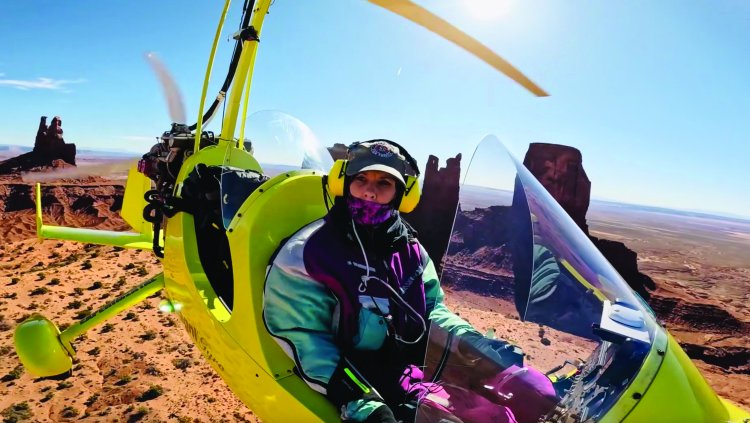
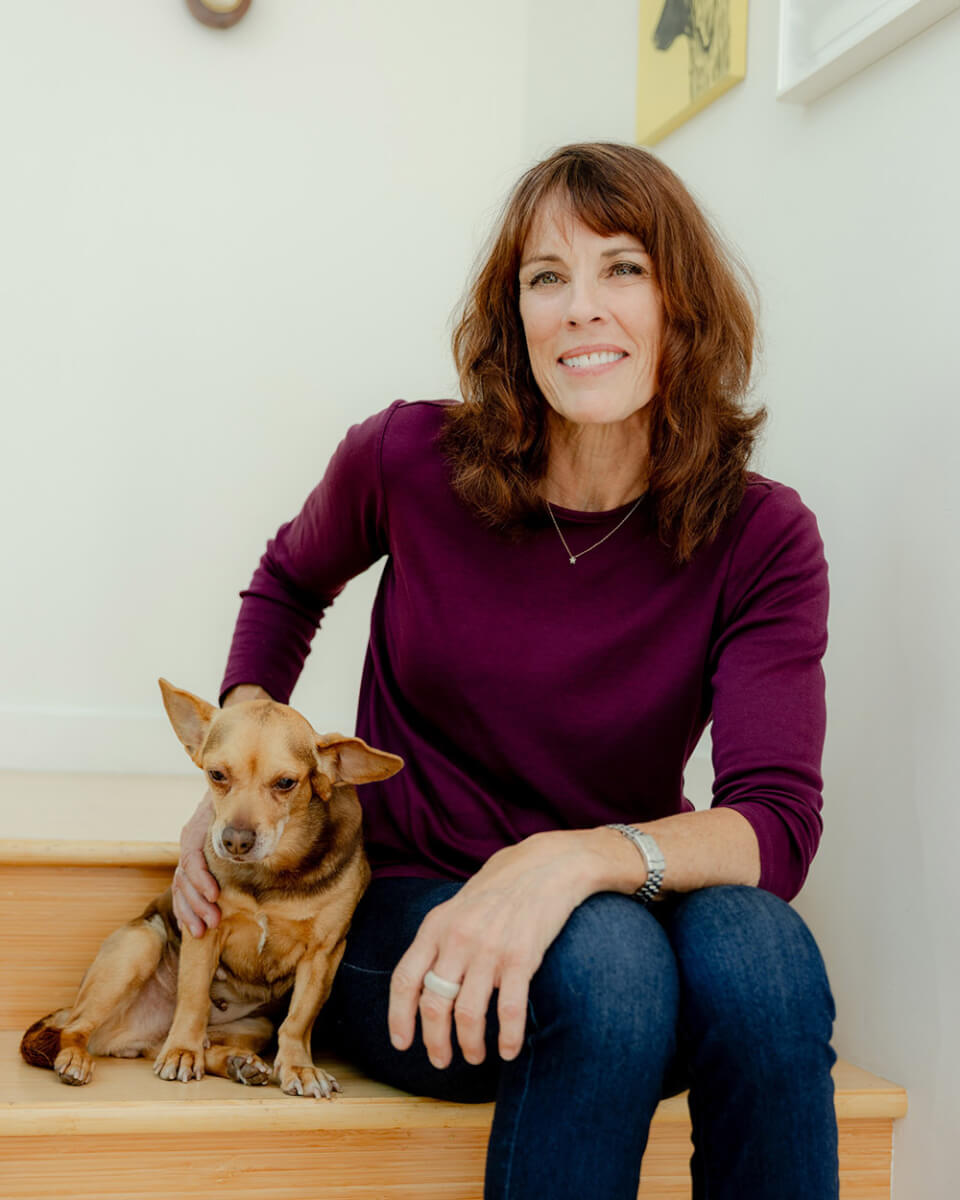
Author photo of Caroline Paul by Cayce Clifford. In-flight photo of Caroline Paul by Caroline Paul.