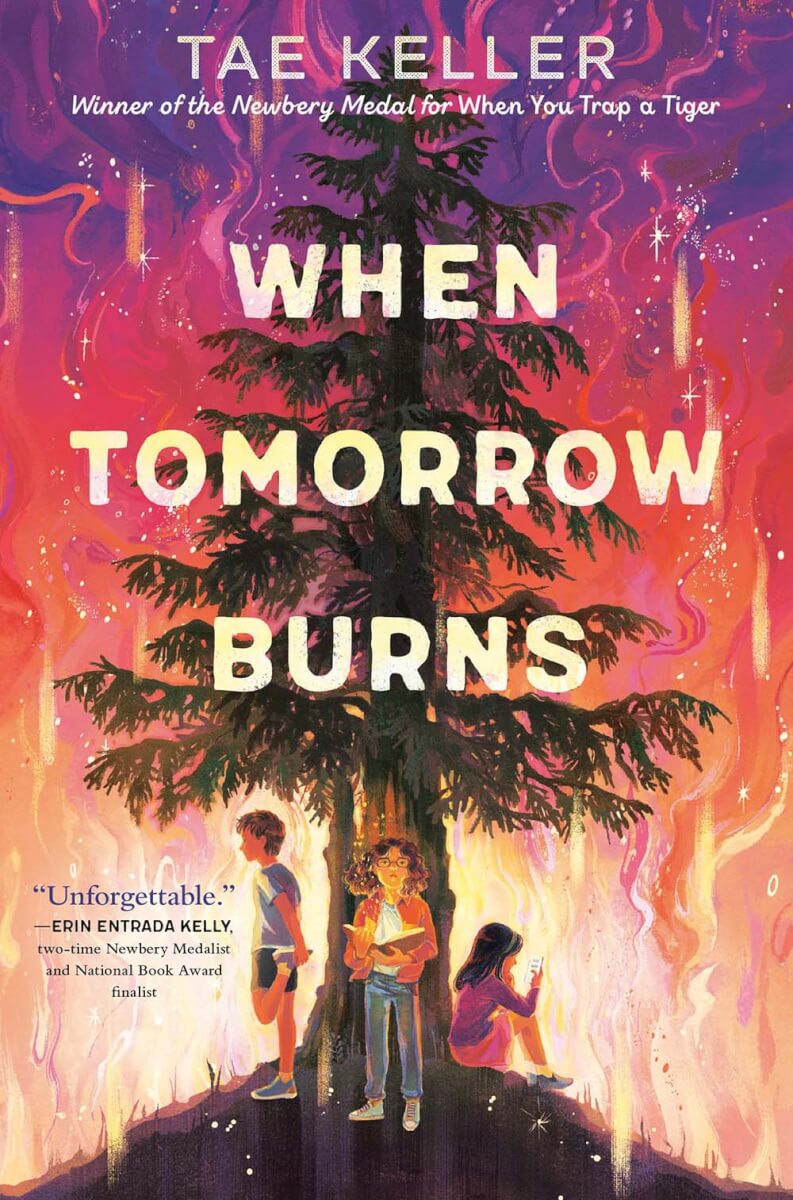
Middle school can often feel like a fiery disaster, and that’s certainly the case for three students in Tae Keller’s marvelous new novel, When Tomorrow Burns. As with her Newbery Medal-winning When You Trap a Tiger, there’s a suggestion of magic. Years ago, the friends found an old book that seems to contain prophecies. Now, the trio sometimes takes refuge under the canopy of a tree outside their school—a tree that occasionally shares its wisdom.
Nomi, Vi and Arthur used to be best friends, but now, in seventh grade, Arthur has stopped speaking to Nomi, while trying to fit in with the cross-country team, especially Lucas, a popular boy who begins texting Vi. However, when another of the book’s predictions seems to come true, the trio cautiously reunites to try to track down the origins of this mystery.
That suspense propels the plot, but ultimately, Keller’s characters, shown in chapters with different viewpoints, raise this novel to another level. Their family situations vary greatly without seeming stereotypically didactic—which they would, in lesser hands. Arthur is doted on by two artsy fathers, Nomi is a scholarship student being raised by a progressive single mother, Vi has a father who works too much and a mother who pours her feelings and frustrations into a secret Instagram account about raising Vi and her sister. Meanwhile, Lucas is a wealthy golden boy with a bullying, entitled father. These seventh graders struggle to find their places in the world and with each other, while trying to deal with the strange new onslaught of hormones.
Keller further elevates the novel with references to the world being on fire. Set in Seattle, ongoing smoke forces Arthur’s track practices to be held indoors, while Vi’s younger sister falls asleep making disaster plans. Keller’s artistry weaves these themes into the plot in often spectacular ways, while also emphasizing the power of friendship and community in the face of both personal and societal challenges. As in real life, endings aren’t always tidy, but readers will be left enriched and hopeful: “There were ways to put that fire out.”
When Tomorrow Burns is a middle-grade version of The Giving Tree, which it references from time to time. It tackles timely issues like sexting, sexuality, economic disparities and, ultimately, the power of nature, community and the written word: “The book had included them, for a moment, but it was bigger than them, in that spindly-tingling way. It was like there was a connectedness, a canopy, a feeling that extended beyond what she could know or see.” The empathy, insight, optimism and wonder of Keller’s prose will speak to fans of Kate DiCamillo.