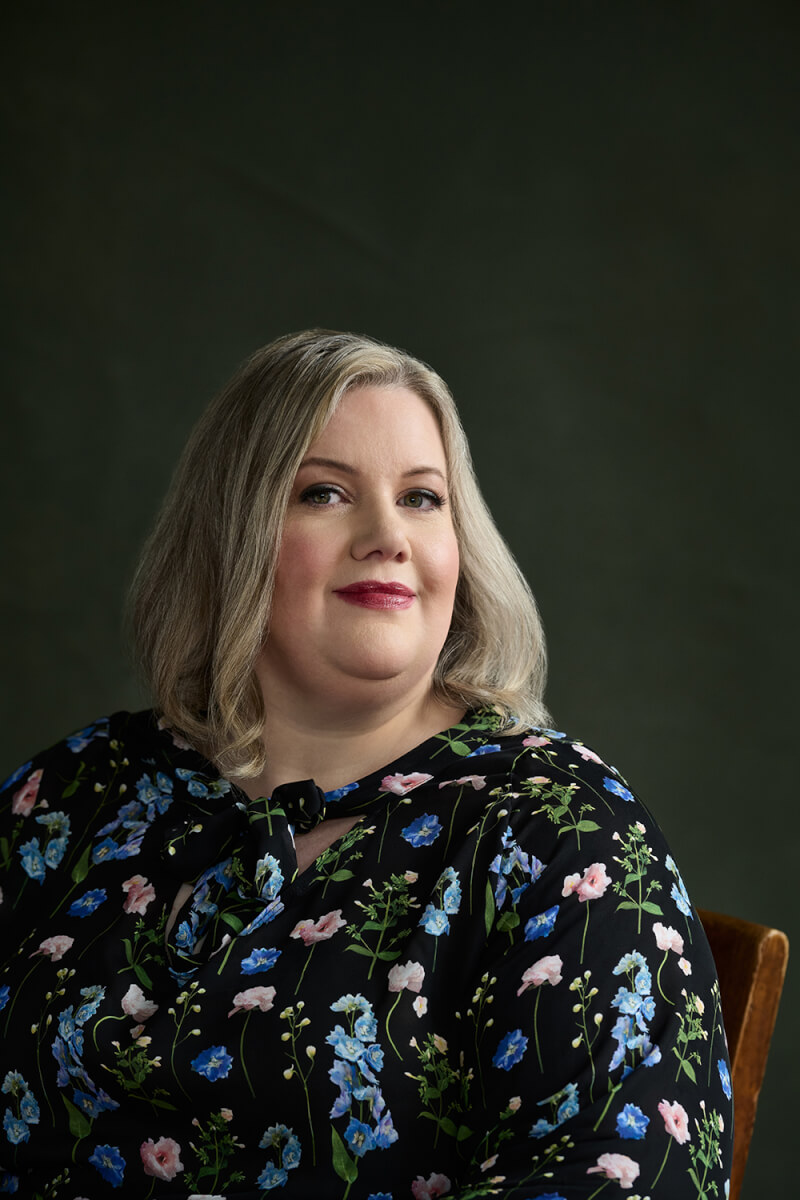
In her bold debut, Dietland, Sarai Walker took on the beauty industry, gender equality and America’s weight loss obsession, all in one deliciously funny, skewering bite. With her sophomore effort, The Cherry Robbers, Walker put a twisted feminist spin on gothic novels in a story about the lone survivor in a family of six cursed sisters. Now, with Furious Violet, Walker has turned to suspense, writing a spine-tingling saga that’s not only funny but thought-provoking—hardly an easy combination. Yet, Walker says, “This book was the most fun I’ve ever had writing.”
“Dietland was really so much about trauma,” she explains, “and I drew a lot from my own life. It’s a fictional story, but I know what it’s like to be a fat woman in America, and that was hard to write. I mostly wrote The Cherry Robbers during the pandemic. It was fun, but it was just kind of a very gothic world—a different head space. And I thought, ‘You know what? I’m really at the point in my life where I don’t want to be tortured by my work. I want to have fun.’ ”
“All of my books are very different in terms of genre,” she continues, “but they all have the common theme of subversive feminist ideas. I feel like the mystery novel was an interesting way to create a page-turning structure that I hope will make readers think about different ideas.” That it decidedly does, making Furious Violet a particularly rewarding thriller, as well as an ideal choice for book clubs.
“I thought, ‘You know what? I’m really at the point in my life where I don’t want to be tortured by my work. I want to have fun.’ ”
The author speaks by phone from the North Carolina coast, where she is staying with family, having just finished up a stint as a visiting assistant professor at the University of Memphis. Meanwhile, she’s selling her own North Carolina home and hoping to relocate, perhaps to the Northeast. “I’m still figuring things out,” she says.
Walker shares her hankering for wanderlust with her latest protagonist, Violet Shelley. Violet—who goes by “West”—is an accomplished true crime writer trying to finish her manuscript about the “Crying Killer,” a serial killer who sobs for his mother after each murder. Although her project has provoked nightmares and panic attacks, West relishes life on the road, guzzling Mountain Dews and surviving “on the kinds of snacks that coated my fingers in orange dust.” “Being disconnected” appeals to her; she prefers to lurk “on the edge of the responsible adult lives everyone else seemed to be living, with their overnight chia oats and fake rice made from cauliflower.”
A fan of Kate Atkinson’s Jackson Brodie novels, Walker decided her third book would be a detective novel, but was determined to avoid the trope of young, unrealistically sexy investigators so often present in movies and TV shows. She sidesteps that with the decidedly unglamorous West, who looks forward to completing her book before her approaching 50th birthday. She totes around a loaded Smith & Wesson revolver inside a diaper bag (despite being childless), along with her laptop, digital recorder, paper and pens.
“That came from a real thing,” notes Walker, who carries such a bag—although she does not carry or own a gun. She saw a similar carry-on bag she liked at a Kate Spade outlet store—black with polka dots—but noticed something strange inside, which the clerk explained was a changing pad.

That diaper bag appears in Walker’s opening scene, in which her protagonist acknowledges that it seems as if her subconscious knows that somehow “mothers were going to be the theme of the weeks and months to come: Mothers real and imagined, mothers dug up.” That maternal theme is explored in many intriguing ways throughout. As a childhood pal tells West, “The Cult of True Motherhood is a hell of a thing. Neither of us fits into it.”
“I don’t have kids, and it’s not a touchy subject,” Walker says. “I’m totally fine with it, and I think it has worked out for the best.” However, she notes that she experiences microaggressions against childless women “all the time.” So does her character. When, for instance, a Mississippi detective informs West, “Only a parent can truly understand the pure evil of murdering a child,” West responds, “Are you . . . serious?”
Walker says she knew that she wanted West to “have this larger-than-life mother looming over her who had died.” Readers will easily see shades of Sylvia Plath and Ted Hughes in West’s famous poet parents, Juliet Bellwood and Hugh Shelley. West lives in the shadow of her late mother, who died in 1975—presumably by suicide—when West was just a newborn. (She was raised by her beloved uncle, Lawton.)
As with her first two books, Walker writes in the first person. “I want the character to be speaking directly to readers as if there’s no author. A lot of parts have a confessional aspect, which I like, because it really allows me to channel the character’s consciousness. I got my Ph.D. in feminist fiction from the 1970s and ’80s, and they used that voice a lot.” She adds that this narrative voice is a “braver, bolder version of me”—without, of course, being autobiographical.
At first, West had a completely different profession—but after 40 or 50 pages, the manuscript “didn’t have any life in it. It was OK, but just didn’t sing.” As she often does when stuck, Walker stopped writing and began reading, which “always helps me find my way,” she says. She devoured two nonfiction books that she hadn’t read before: Truman Capote’s In Cold Blood and Michelle McNamara’s I’ll Be Gone in the Dark.
“Imagine, if your family member got murdered, and then people are eating popcorn and watching Dateline about it.”
That’s when Walker decided to make West a true crime writer. “And then she started talking to me,” Walker remembers.
While acknowledging that controversy surrounds Capote’s classic work, especially in terms of accuracy, Walker says, “The writing is stunning. I think he really got to something in that book that’s just sort of in American culture, especially gun violence and the senseless violence. He really nailed that. I thought it was the saddest book that I’ve ever read.” (Walker includes her own piercing zinger in her novel, having West comment, “I had a car, a phone, a credit card, and a loaded gun—what more did anyone need to survive in America?”)
Walker says her Crying Killer is “like a Utah version of the Golden State Killer”—he kills only Mormons. She greatly admires McNamara’s book on the serial killer, saying the author’s tragic death robbed readers “of everything she could have done.” (She did not, she notes, model West after the late writer.)
True crime has always intrigued Walker, and, in fact, it’s the subject of one of her earliest memories. In the late 1970s in Palm Springs, California, one of her neighbors was robbed and murdered in broad daylight. Since she was so young, Walker remembers little about the man except that he wouldn’t open his door on Halloween: “We heard him in there laughing with his girlfriend when my sister and I knocked on the door.” He evidently kept a lot of cash on hand, and, as the crime occurred, Walker, her mother, grandmother and sister were returning home at lunchtime. Her mother noticed a man in a car outside the neighbor’s house, while another man stood at the front door talking to the neighbor, which she thought was strange. The case has never been solved.
While writing Furious Violet, Walker immersed herself in research—listening to podcasts, attending a CrimeCon convention and going on a “crime cruise.” “It’s a smaller version of CrimeCon—just on a cruise ship,” she explains. “So, I learned a lot more because I could talk to people and ask them questions.” (There, for instance, she met Paul Holes, a former cold case investigator who provided McNamara with key case files and insights on the Golden State Killer.)
Walker acknowledges that the increasing popularity of true crime is problematic. “Imagine, if your family member got murdered, and then people are eating popcorn and watching Dateline about it. There’s always this tension there.” By the end of the novel, West voices the inherent dilemma of her profession, noting, “True crime is about what happens to other people. But when it happens to you? That’s a different kind of story. That’s horror.”
Read our starred review of ‘Furious Violet’ by Sarai Walker.
While West obsesses over various cold cases, she bristles at the attention paid to her late mother. Her uncle calls Juliet’s obsessed fans the “Furies,” and West loathes them as well. When West crashes at Lawton’s Colorado home, the Furies are planning a symposium marking the 50th anniversary of Juliet’s death, organized by English professor Margo Dyle. When West begins to receive a series of creepy, bizarre messages from someone claiming to be her child, she begins to wonder if one or several of the Furies may be to blame.
West was greatly influenced by Plath’s legacy when creating Juliet’s character. She fell in love with Plath’s writing in her early 20s, and while in London, visited the house where she died. She attended a reading that Plath’s husband, Hughes, gave with Seamus Heaney, and was studying in England during a Plath conference in 2005. “All these people who were obsessed with Sylvia Plath was kind of interesting,” she recalls, “but scary at the same time. It was weird. And it made me think about literary celebrity in a new way, and think, ‘Do I really want to be part of that?’ ”
In 2018, Plath’s daughter auctioned off some of her parents’ belongings, and at first, Walker briefly contemplated buying something. “And then the prices ended up being insane,” she says. (Plath’s heavily underlined thesaurus sold for $19,491; her Joy of Cooking, with “Ted likes this” written next to a recipe for breaded veal slices, was bought for $6,201.) So instead of buying something, Walker included an auction of Juliet’s belongings in her novel.
In addition to weaving in quirky details like that, Walker has fun naming her characters. West’s parents’ names evoke poetic references, and West’s childhood hometown sounds right out of a Hallmark movie—Copper Mallow, Colorado. “I love names and I put a lot of work into the names,” Walker says. “I think it’s because I have a unique name that no one’s going to say or pronounce or spell. So, it was really part of my identity—I’m the girl with the weird name.” (For the record, her name has biblical origins and is pronounced sa-RAY.)
Walker and her family moved from Palm Springs to Utah at age 8. “It was a huge culture shock,” she remembers. (She was raised Mormon, but is no longer religious.) At age 17, she won a national short story contest sponsored by teen magazine Sassy. She later majored in English at the University of Utah, where she studied with Pam Houston (Cowboys Are My Weakness), whose classes she says were influential. Later, she earned an MFA at Bennington, and then a Ph.D. at the University of London. “It took me a long time,” Walker muses. “I didn’t publish my first novel until I was 42.”
But she says “Dietland is a book I just couldn’t have written when I was younger. I felt like things worked out as they were supposed to.”
As an adult, she was also diagnosed with ADHD, which, she says, “explains a lot.” “Dietland took me a really, really long time to write. Now I’m very disciplined and know how to work with my habits.” She’s naturally a night person, for example, but has trained herself to write first thing in the morning—“before I get distracted by lots of other things.”
She uses a bulletin board to surround herself with helpful visuals for each novel. For this book, she chose Colorado photographs of “moody forests and woods.” For The Cherry Robbers, there were Victorian houses and 1950s clothes and flowers. Right now, she admits, her mood board sits empty. “I’m just starting the process of building my new bulletin board,” she says. Teaching gave her no time for writing, but she looks forward to writing another feminist suspense novel.
Might readers see more of Violet “West” Shelley?
Her current project does not involve West, Walker says. And although she has never been interested in writing a sequel to Dietland, another Furious Violet novel might be another story, literally. Walker acknowledges, “That’s something I haven’t ruled out. There would have to be a kind of big demand for it, but I’m definitely open to that for sure.”
Photo of Sarai Walker by Kyle Kielinski.