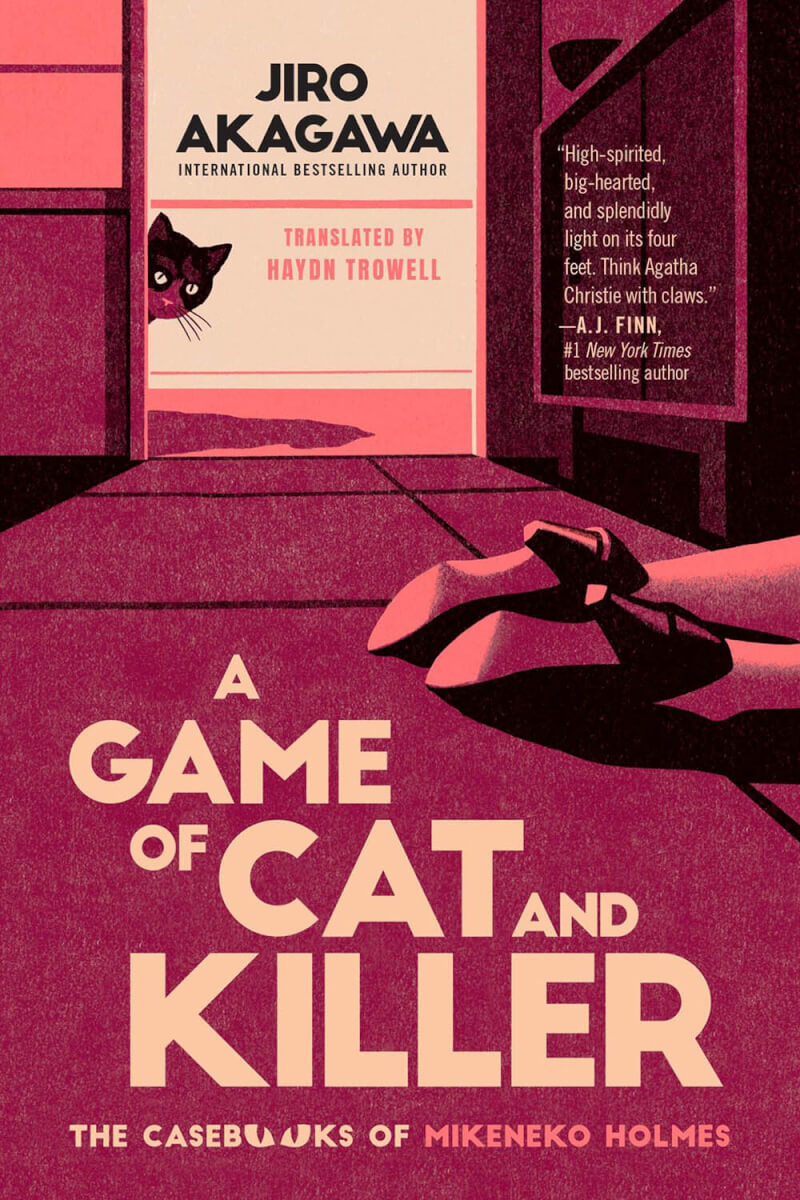
A Game of Cat and Killer
The subtitle of Jiro Akagawa’s novel A Game of Cat and Killer is “The Casebooks of Mikeneko Holmes,” “mikeneko” being the Japanese word for “calico cat.” As you might guess, casebooks suggests that this is the first book of a series; as you might not guess, the novel was published in its original Japanese in 1978 and is the first in a series that now numbers 70-odd installments (counting short story collections), which have together sold a whopping 25 million copies. The stories feature a rather reluctant police detective, Yoshitaro Katayama, and Holmes, the cat who attaches itself to him. In this first installment, available in English for the first time after being translated by Haydn Trowell, Katayama investigates the murder of said cat’s previous owner, a university professor. This could have been a setup for a cutesy cozy novel, with a clever narrating cat that outsmarts its dull-witted human servants at every turn, but it is not like that at all. Certainly this is due in part to the body count, which is impressive, to say the least. Picture instead an Agatha Christie locked-room mystery in which a cat plays a pivotal role, moving the narrative forward in unexpected—but by no means supernatural—ways. It is a formula that has worked exceptionally well in Japan, having spawned several TV and film adaptations as well as an animated series. If you love it, you will not have to wait long for the second installment: A Copycat Killer is due in March 2027.
Murder on the Sacred River
Tasha Alexander’s Murder on the Sacred River finds the redoubtable Lady Emily and her adventurous husband, Colin Hargreaves, in colonial India, circa 1908. They are vacationing at Ahilya Fort in Maheshwar, once the home of Maharani Ahilyabai Holkar, a real-life queen in the 18th century (more on that later). The vacation comes to an abrupt halt due to a murder, not an uncommon event in the lives surrounding those of Lady Emily and her husband. Put all of that on hold for a few moments, though, as the following chapter takes readers back to the year 1740, when a 15-year-old girl named Ahilyabai lives in the maharaja’s residence. She has been married to the maharaja’s son since she was 8, although she does not meet with him often, as he is a rather unlikable fellow, a drunkard, a womanizer and a general layabout. She, on the other hand, is kindhearted, generous of spirit, and—unbeknownst to her—on the pathway to veneration by generations of Indians to come. Oh, and there will be some treasure involved, and nothing gets English colonists excited like hidden treasure. Back in 1908, another murder takes place. The suspect list for both killings is long and meaty. There is one woman borderline stalked, another woman scorned and a dodgy fellow known by a host of different aliases over the course of his criminal career. Oh, and let’s not forget the treasure. Alexander toggles back and forth between the mid-18th century and the early 20th century, deliberately ratcheting up the tension in this excellent addition to an excellent series. When it comes to dual narratives of different eras, nobody does it better.
★ Witch Trial
Let me start this review by saying that Harriet Tyce’s Witch Trial is the strangest mystery I have read in ages, maybe ever. The plot line is simple enough to begin with: Two teenage girls are on trial in Edinburgh’s High Court for the murder of a classmate. The prosecution claims that they had bullied their classmate, threatening her with death, even though they knew that the girl had a heart condition in which stress could prove fatal. The defense claims that the defendants are witches, and they were not threatening their classmate, but merely warning her, following their alleged conversations with the capital-D Devil. Heart surgeon Matthew Phillips is one of the jurors, likely the most educated of the lot, and certainly no believer in witchcraft—until some inexplicable things begin to take place around him, causing him to question a lot of the assumptions he has held sacrosanct all these years. Part of this may be down to the fact that Matthew is under a lot of stress. Work is problematic, home life is worse. The call to jury duty is almost a reprieve. And then it isn’t. After long deliberation, the trial draws to a close, bringing with it a mix of closure and loose ends, but the story is by no means over: a series of documents following the narrative shed lots of insight and more than a few “aha moments” as the inexplicable gets explained. Witch Trial is just brilliant, through and through.
★ Die Famous
There are three major characters in Michael Koryta’s Die Famous. Each bears a legacy of difficulties; each owes that legacy in some part to the other two. Eddie “Nickel” Terhune is an ace car mechanic, getaway driver and thief. There’s Eddie’s onetime lover Savannah Cody, with whom he has had a tortuous, off-and-on relationship over the years. And then there’s their son, Alford, who’s been abandoned at one time or another by each of his parents, often by both at the same time. Eddie’s story is in the third person, Alford reveals his story in the first person and Savannah’s story is revealed in a series of confessional interviews with an FBI agent. Together they spin a tale of teenage infatuation that grows into something deeper and more dangerous, a crime spree worthy of Bonnie and Clyde, and a reckoning that will drastically change some lives and end others. Die Famous features all the shoot-em-up action you could possibly want from a 1930s-set gangster novel, but it also brings an element of introspection to the mix. I will make two predictions here: 1) This book will be optioned for a movie; it reads like a screenplay even as it stands, and 2) it will go down in literary history as one of the best gangster novels ever. It is really that good.