Tories and Reform UK accuse Mahmood of surrendering to ‘open-borders Labour left’
Chris Philp, the shadow home secretary, is already ridiculing the indefinite leave to remain (ILR) announcement coming this afternoon. In a post on social media, he claimed that she was surrendering to “the open-borders Labour left”.
Later today the government will announce their u-turn on ILR, or Indefinite Leave to Remain.
It’s clear Shabana Mahmood has been forced to surrender to Angela Rayner and the open-borders Labour left. She will now allow hundreds of thousands of low-wage and no-wage migrants to stay in the UK forever and claim benefits.
By Mahmood’s own admission in a speech this March, letting low wage care workers alone stay forever will cost taxpayers £10 billion and be an “affront”. Now it looks like she’s about to do exactly that. After talking tough all year, Mahmood appears to have capitulated control of immigration policy to Angela Rayner – and Mahmood’s position is looking increasingly untenable
The Conservative plan is a ten year route to ILR, only for high wage workers. No more low wage workers should be allowed in, and those already here should be required to leave when their temporary work visa expires
Nigel Farage, whose Reform UK party wants to get rid of ILR completely, has made a similar argument in his own social media post.
The Labour Party is at war with itself over Indefinite Leave to Remain (ILR), with Home Secretary Shabana Mahmood losing a fight to the far left of her own party. Tomorrow, she’s expected to cave on plans to even tinker with the ILR numbers. Angela Rayner emerges victorious, with her defence of the Tory-era policies hinging on “fair play” towards foreign nationals.
But what about fair play towards the British public? Doesn’t that count for anything anymore? Villages, towns, suburbs, and cities have to deal with the weight and strain of all this. Not only are ordinary Brits never consulted, but this current cabinet doesn’t even have an electoral mandate. It is rightly infuriating to most people who increasingly want net negative migration into Britain.
Key events
At the lobby briefing, the PM’s spokesperson rejected suggestions that Shabana Mahmood’s ILR statement has been timed today to coincide with Andy Burnham being out of the country. “I don’t accept that,” the spokesperson said, when the idea was put to him.
Asked if Burnham thought legal migration was still too high (see 9.22am), the spokesperson said it was “a good thing” it had fallen.
No 10 denies report claiming Burnham open to UK boosting payments to Commonwealth countries to atone for slavery
Downing Street has denied a report claiming that Andy Burnham is open to the UK paying some form of slavery reparations.
This morning the Daily Telegraph has splashed on a story saying Burnham is “open to increasing financial assistance for Commonwealth countries to help atone for Britain’s role in the slave trade”.
Asked about this at the lobby briefing, the PM’s spokesperson said:
The story is wrong. We’re not setting up a reparations fund. We’ll not be making additional aid allocations on top of existing budgets …
The position on reparations is clear: acknowledging the horror of the transatlantic slave trade and considering a formal apology for Britain’s role in it does not mean accepting a present-day financial liability.
Burnham has been strongly criticised by Kemi Badenoch and by Nigel Farage for agreeing to discuss a formal apology for the role played by Britain in the slave trade with Commonwealth leaders.
The spokesperson said that, in agreeing to discuss this, Burnham was doing “the patriotic thing”. He explained:
The prime minister wants to strengthen the Commonwealth as a family of nations with shared values that can support growth around the world through trade and economic collaboration. And as he said in his op-ed, having these difficult conversations to safeguard the Commonwealth for the future is the right thing to do.
It’s also the patriotic thing to do, not just because it’s in our interests, but because the Britain I believe in, he said, is confident, decent, and brave.
When it was put to him that Tony Blair had already in effect apologised for the role played by Britain in the slave trade (one of the arguments made by Badenoch), the spokesperson replied:
The prime minister, like his predecessors, has expressed his sorrow and regret for the pain and suffering caused by the transatlantic slave trade, and recognised the way it still shapes our world today. That is distinct from a formal apology.
We’re opening a structured dialogue with those affected by the transatlantic slave trade, and listening to calls for a formal apology on behalf of the British state, and that will form an important part of that process.
We think it’s right that a formal apology is discussed properly with the countries and communities most affected, rather than simply deciding unilaterally what form it should take. An apology of this significance should be informed by the people and countries most affected, as they’ve asked for.
No 10 defends government plane flying from Stansted to Caribbean for summit stopping in Manchester to pick up PM
Downing Street has declined to say how much it cost for the plane carrying Andy Burnham and UK delegates to a Commonwealth leaders’ summit to stop in Manchester to pick him up (see 10.28am), the Press Association reports.
At the morning lobby briefing, asked if this was an appropriate use of public money, the PM’s spokesperson said:
The prime minister’s travel arrangements are made on the basis of security, operational requirements, and value for money for the taxpayer.
The prime minister’s travel arrangements reflect where he was carrying out official government business at the end of last week.
As you know, he spent the day in Scotland on Friday, returned to Manchester to work from Number 10 North on Friday evening. In terms of costs, travel costs will be published in the usual way.
Shabana Mahmood, the home secretary, will make her statement about indefinite leave to remain at 3.30pm, the Commons authorities have confirmed. There are no urgent questions, and no other statements. Mahmood’s statement is billed as being about “earned settlement”.
Downing Street has defended Andy Burnham’s decision to discuss the case for an apology for slavery at the Commonwealth summit.
Asked about the controversy about the PM’s comments in a Guardian article ahead of the meeting, the PM’s spokesperson told reporters at the daily lobby briefing:
The prime minister wants to strengthen the Commonwealth as a family of nations with shared values and support economic cooperation.
The prime minister, like his predecessors, expressed his sorrow about slavery – that is separate to a formal apology.
We think it’s right that a formal apology is discussed with the countries and people most affected.
A Conservative former transport minister said he took “full responsibility” after using his phone while driving, leading to a fine and six penalty points on his licence, the Press Association reports. PA says:
George Freeman was caught checking his phone behind the wheel by a cyclist who reported him to the police.
Mid Norfolk MP Mr Freeman pleaded guilty at Stratford magistrates’ court on 1 September to using a handheld mobile phone while driving, according to The Mirror.
The newspaper reported he was fined £430, as well as having to pay a surcharge of £172 to support justice services and £130 in costs to the Metropolitan police.
The MP said he had been checking a navigation app while stuck in traffic.
He told The Mirror: “I was sitting in gridlocked traffic and checking Waze on my phone. I took full responsibility and deeply regret my actions.”
Recruitment of foreign care workers on course to fall to just 10,000 in 2026/27, thinktank says
The King’s Fund, a health thinktank, is warning that Shabana Mahmood is planning to tighten the residency rules for foreign workers when the number of overseas care workers being recruited is already on course to fall to 10,000 a year.
And this is happening as vacancies in the sector increase, it says in its analysis. It explains:
Overseas care worker recruitment is falling from its high point of 105,000 in 2023/24 to 30,000 in 2025/26, with it trending to fall to 10,000 in 2026/27. In 2025/26 there were 1.02 million filled direct care independent sector posts and 65,000 vacancies. Vacancy rates in the social care sector are above average when compared with others.
Alongside a decline in the number of international recruits, the number of new domestic workers starters in care work is also falling – with now more leaving than are starting. There were 140,000 new British starters in 2025/26, down from 255,000 in 2020/21, compared with 175,000 who left the sector in the last financial year.
Danielle Jefferies, a senior analyst, said the fall in the number of foreign care workers coming to the UK would “present challenges”. She said:
The divergent trend lines of the growth in demand for care workers and the expected fall in new international recruits that the sector relies on, paints a bleak picture for where the social care workforce will be unless there is significant intervention from the government.
Foreign skilled workers eligible for ILR before end of decade set to contribute £115bn to economy, thinktank says
Shabana Mahmood has justified her proposal to make it harder for low-skilled workers, including care workers, to qualify for indefinite leave to remain (ILR) on the grounds that they will be a net burden on the taxpayer. In his statement (see 10.12am), Chris Philp referenced a claim she made in a speech in March when she said:
We have never, in the history of this country, had so much low-skilled migration in so little time. We estimate, based on findings from the migration advisory committee … That the lifetime cost to the taxpayer will be £10bn.
At the time, the Home Office published a document explaining how they arrived at the £10bn figure.
The IPPR, a left-leaning thinktank, has published a briefing today suggesting this figure is miseading because it does not present the full picture. It says:
The £10bn figure should be put in wider context. New IPPR analysis suggests that, as a whole, the estimated net lifetime fiscal contribution of all skilled workers (including health and care workers) who were expected to settle in 2026-30, along with their adult dependants, is roughly £115bn. This follows the same approach as the Home Office in calculating the £10 billion net cost for care workers and adult dependants (see methodology below for more details). The risk of deterring skilled workers who make a significant fiscal contribution should therefore be an important consideration for the final set of proposals.
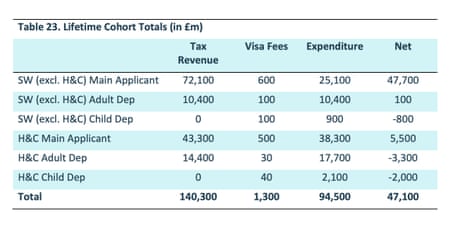
Both the Home Office and the IPPR are using from a report published by the migration advisory committee (MAC), The Fiscal Impact of Immigration: Static and Dynamic Estimates for the UK. It was published in December last year and it focuses in particular on people who came to the UK in 2022/23 on skilled worker (SW) visas, and on people with health and care worker (H&C) worker visas. The report contains figures supportive of both sides of this argument.
It says that, for most categories of foreign worker visas, the people who receive them will make a net contribution to the economy over the course of their lifetimes. The only exceptions are dependant children, and adult dependants of people on H&C visas.

These calculations involve working out whether the amount that people will contribute in taxes over the course of a lifetime will outweigh the amount they will cost due to benefits claimed or healthcare consumed (or education costs, if they are children). To work this out, economists need to make assumptions about how much people will earn, when they will retire, and how long they will live.
This chart illustrates the pattern. It shows how the 2022 H&C main applicants (ie, not dependants) are expected to contribute for the next 30 years, before they start becoming a net burden.

But the MAC does say that care workers (a subset of H&C workers) will be a net burden. It says:
The H&C workers are less fiscally positive compared to UK residents of the same age (though much better than the median) – but there is still the additional benefit to the fiscal balance of having more younger workers than the UK average. We can split this group of main applicants into those who came as care workers and those who came in other health and care occupations (mainly nurses and doctors). For care workers, the lifetime contribution is estimated to be -£36,000, whilst for the other occupations it is +£166,000. Care workers are therefore fiscally negative over their lifetimes and broadly similar to the UK median for the age group.
The report also makes the point that most UK residents will, over the course of their lifetimes, end up being a net burden. But it says “because our tax system is strongly progressive, the upper end of the income distribution contribute much more than the median”. This means that, even though the average Briton using the median definition is a net cost, the average Briton using the mean definiton puts in enough to keep the system going. These figures illustrate this point.

Andy Burnham is now on his way to the Commonwealth summit in Antigua. The government plane that is taking him left from Stansted early this morning, but it went to Manchester first, where it stopped to pick up the PM. He is now en route to the Caribbean, where he will arrive this evening after a refuelling stop in Canada.
Tories and Reform UK accuse Mahmood of surrendering to ‘open-borders Labour left’
Chris Philp, the shadow home secretary, is already ridiculing the indefinite leave to remain (ILR) announcement coming this afternoon. In a post on social media, he claimed that she was surrendering to “the open-borders Labour left”.
Later today the government will announce their u-turn on ILR, or Indefinite Leave to Remain.
It’s clear Shabana Mahmood has been forced to surrender to Angela Rayner and the open-borders Labour left. She will now allow hundreds of thousands of low-wage and no-wage migrants to stay in the UK forever and claim benefits.
By Mahmood’s own admission in a speech this March, letting low wage care workers alone stay forever will cost taxpayers £10 billion and be an “affront”. Now it looks like she’s about to do exactly that. After talking tough all year, Mahmood appears to have capitulated control of immigration policy to Angela Rayner – and Mahmood’s position is looking increasingly untenable
The Conservative plan is a ten year route to ILR, only for high wage workers. No more low wage workers should be allowed in, and those already here should be required to leave when their temporary work visa expires
Nigel Farage, whose Reform UK party wants to get rid of ILR completely, has made a similar argument in his own social media post.
The Labour Party is at war with itself over Indefinite Leave to Remain (ILR), with Home Secretary Shabana Mahmood losing a fight to the far left of her own party. Tomorrow, she’s expected to cave on plans to even tinker with the ILR numbers. Angela Rayner emerges victorious, with her defence of the Tory-era policies hinging on “fair play” towards foreign nationals.
But what about fair play towards the British public? Doesn’t that count for anything anymore? Villages, towns, suburbs, and cities have to deal with the weight and strain of all this. Not only are ordinary Brits never consulted, but this current cabinet doesn’t even have an electoral mandate. It is rightly infuriating to most people who increasingly want net negative migration into Britain.
‘Was I not enough?’: care worker barred from meeting home secretary tells his story
Shabana Mahmood, the home secretary, is due to meet some union leaders today to discuss with them her plans for indefinite leave to remain. Andrea Egan, who as Unison general secretary has many members working in the care sector, has been particularly critical of the original proposal to make foreign care workers wait 15 years for ILR. Recently she condemned Mahmood for refusing to let her bring a care worker to a meeting they were due to have about the plans.
That care worker was a Nigerian called Kolade. Aamna Mohdin has interviewed him, and he explained what he wanted to tell Mahmood.
For Kolade, the row encapsulates what he believes is missing from the immigration debate: the voices of those whose lives could be upended by its policies. He has watched politicians dismiss care work as low-skilled and portray migrant workers as a burden on the British economy.
“I was just going to tell her that is not correct,” he said. “We are not a burden to the British state. We are also contributing as much as we can, supporting British families.
“She talked about fairness to the British people. I was going to tell her that caring for British families is our own little way to show that we are contributing, and that we have earned our rights to stay in this country, a place we’re currently calling home.”
Here is Aamna’s article in full.
Burnham declines to say net migration still too high as Mahmood prepares to unveil tougher settlement rules
Good morning. Often these days, when the government has a big announcement and just before the relevant minister starts to give the details in a statement to MPs, Lindsay Hoyle, the Commons speaker, erupts with fury and rants and raves at the Treasury bench about how all the main points have already been leaked to the media, in contravention of the ministerial code.
Not today. Shabana Mahmood, the home secretary, will this afternoon unveil the final version of her plans to make foreign workers wait longer before they can apply for indefinite leave to remain, and we know relatively little about what she will say. The original plans were unveiled last November and they would require most workers to wait 10 years, not five, for ILR, with care workers having to wait 15 years. They would also apply to foreign workers already here, not just new arrivals. These proposals were hugely controversial, and Andy Burnham himself was among the ministers arguing that care workers should be treated more kindly.
As Jessica Elgot and Chris Osuh report in our overnight story, there has been some sort of climbdown in relation to care workers.
But it also seems to be the case that the broad thrust of the plan is being retained and that ILR rules are being toughened in a way that will affect hundreds of thousands of people.
The detail, which is coming after 3.30pm, will be crucial; so will the reaction of Labour MPs. When Mahmood announced these plans last autumn, some government backbenchers were horrified. But mostly public condemnation was muted. At the time Reform UK had a lead of more than 10 points over Labour in the polls and Mahmood – who was arguing that net migration was too high and that low-skilled foreign workers ended up being a burden on the taxpayer (a key Reform UK claim, although one contested by experts) – was pushing at an open door.
Now the situation is very different. The electoral threat from Nigel Farage has receded quite a lot. And net migration is falling like a stone. Here are the figures from last week’s OBR report.

To implement the ILR changes, Mahmood does not need primary legislation and that means there will be no chance for potential Labour rebels to amend the plans in the Commons. But it has been reported that more than 100 MPs are queasy about what is being planned.
And Andy Burnham himself has accepted that the context has changed. We won’t hear from him until much later, because he is spending most of the day on a flight to the Commonwealth summit. But, in an interview for an ITV documentary being broadcast tomorrow, he declined to say that net migration was too high. When Keir Starmer was PM, he regularly did say this, and that he wanted immigration to fall “significantly”. Burnham told ITV small boat crossing numbers were “too high, for certain”. However, asked about legal migration, he replied:
It’s come right down. And I think when you have planned migration, it’s difficult to say is it too high or too low, because it’s got to be, if you like, following gaps in the economy.
Burnham said legal migration had “come right down”. He declined to be drawn on whether it had to come down further.
This means that Mahmood will today be defending plans drawn up in response to a problem that some might argue no longer exists. However, speaking in the Commons last November, Mahmood argued she had to do something about the “so-called Boriswave, specifically the cohort of lower-qualified workers who – along with their dependants – entered the country through the health and care visa” because some of them were “never expected to be net economic contributors”, making “more stringent” controls needed.
Here is the agenda for the day.
11.30am: Downing Street holds a lobby briefing.
12.30pm: Danny Kruger, Reform UK’s head of government preparations, gives a speech to the Policy Exchange thinktank.
2.30pm: Angela Rayner, the housing secretary, takes questions in the Commons.
After 3.30pm: Shabana Mahmood, the home secretary, gives her statement on the changes to indefinite leave to remain rules.
Evening: Andy Burnham arrives in Antigua for the Commonwealth summit.
Also, at some point today Labour will give an update on how many power-sharing agreements at council level with Greens will continue, in the light of Labour HQ saying recently Labour councillors should only continue to work with local Green parties willing to disown the “Zionism is racism” motion passed at the Green conference.
I’m afraid we are no longer able to have comments open below the line every day on this blog. If you want to contact me, please email politics.live@theguardian.com. You can use this email to flag up corrections, comments for publication, questions or complaints.